While our forests are lush, they find themselves throttled by private brokers who translate wilderness and its kin into profit margins. Rivers are asked to cool the fever dreams of artificial intelligence and endless growth. Whales making their sojourns through oceanic ancestral pathways are now navigating increasingly saturated noise, heat, and debris, their old pathways of migration become uncertain, as does the sustenance of the deep. These old agreements between bodies and places become strained, they wash up on the shores of beaches.
And we, moving through our days carrying bewilderment as the ancient fears of our scarcity ancestors rise, are left wondering if we have the capacity to grieve their passing as well as own own, because this ancient scarcity script is saturated with a survival instinct in a world that has instilled individualism over collective care. And our institutions once entrusted with mutual belonging have been intentionally incapacitated, as the new regime reveal themselves unwilling to hold the ethos of ecologies of care.
Political certainties harden into competing fundamentalisms while the ground beneath them continues to shift. Everywhere there are calls for more efficiency, more extraction, more innovation, as though the crises surrounding us are merely engineering problems awaiting better management.
Perhaps what we call crisis is not simply the failure of our systems but the fraying of the sacred threads that once bound meaning to place, responsibility to relationship, and human life to the wider community of beings.
Perhaps the unraveling we witness is not evidence that the world has abandoned us, but evidence that the world exceeds the narrow terms through which modernity has attempted to name, order, and contain it. We have become, in many ways, unmoored from the living intelligences that sustain us.
Yet beneath the surface of collapse, other patterns persist. The forests, the whales, the rivers, the disappearing glaciers, the exhausted worker, the anxious child, and the polluted watershed do not occupy separate categories of concern. They are entangled within a larger disturbance, a mycelial condition of interdependence and injury, where ecological, political, spiritual, and economic fractures move through one another like roots beneath the soil.
The Summer Solstice arrives within this bewildering terrain as a reminder that thresholds rarely announce themselves politely. At the very height of light, darkness has already begun its return. What appears stable reveals itself to be turning. What seems complete is already entering another phase of becoming. The longest day is not a monument to permanence but a threshold. Even at the apex of light, the turning has already begun. The oak does not mistake its leafing for immortality. The river does not cling to a single shape.
Across the living world, abundance and decay, flourishing and loss, are braided together in an intimacy our industrial myths have taught us to forget. To stand within this season is to remember that we are not separate from these cycles but participants in them, creatures woven into a vast, animate conversation. Because the world does not move according to the linear promises of progress that have so thoroughly shaped the imagination of modernity. It moves more like a forest floor, where decay and emergence remain inseparable, where endings feed beginnings, and where unseen mycelial networks carry nourishment, memory, and possibility through darkness toward futures no single creature can fully anticipate.
The sacred is not elsewhere. It is woven through these exchanges, through the reciprocity of soil and root, river and rain, grief and renewal.
Perhaps the invitation of this season is not to seek firmer ground but to learn how to inhabit the trembling.
Not as masters of a world in crisis, nor as victims awaiting rescue, but as participants in a living and unfinished conversation whose outcome remains beautifully, and sometimes terrifyingly, uncertain. To remain present at the threshold. To listen for what is emerging beneath the noise. To remember that even in times of unraveling, the world continues its patient work of weaving new relations from what has come apart. For once the sun reaches its greatest height, the wheel quietly begins its turn toward darkness. The Earth, as she so often does, reminds us that culmination and descent belong to the same story.
For much of human history, human life was not separated from the wider choreography of the world. It moved inside it.
Bodies learned time not as abstraction but as relation. Time arrived as scent, as temperature, as the pressure of light across skin. The living world was not backdrop but interlocutor. A speaking field of kinship.
Seasonal thresholds were entered not marked as obligations. Ritual emerged as a form of accompaniment, as a way of staying in conversation with the turning of the seasons and the other than human kin. Communities gathered to weave the commons of care. People lived close enough to these rhythms to feel them moving through their own bodies. The migrations of animals, the arrival of rains, the flowering of plants, and the shifting patterns of light were not events observed from a distance but relationships inhabited through daily life.
As time itself possessed texture and character. It arrived through the scent of blooming hawthorn, through the return of salmon to ancestral waters, through the first frost settling upon harvested fields. The turning of the seasons offered recurring invitations to enter more deeply into the living fabric of existence, and ritual emerged as one of the ways communities participated consciously in that larger unfolding.
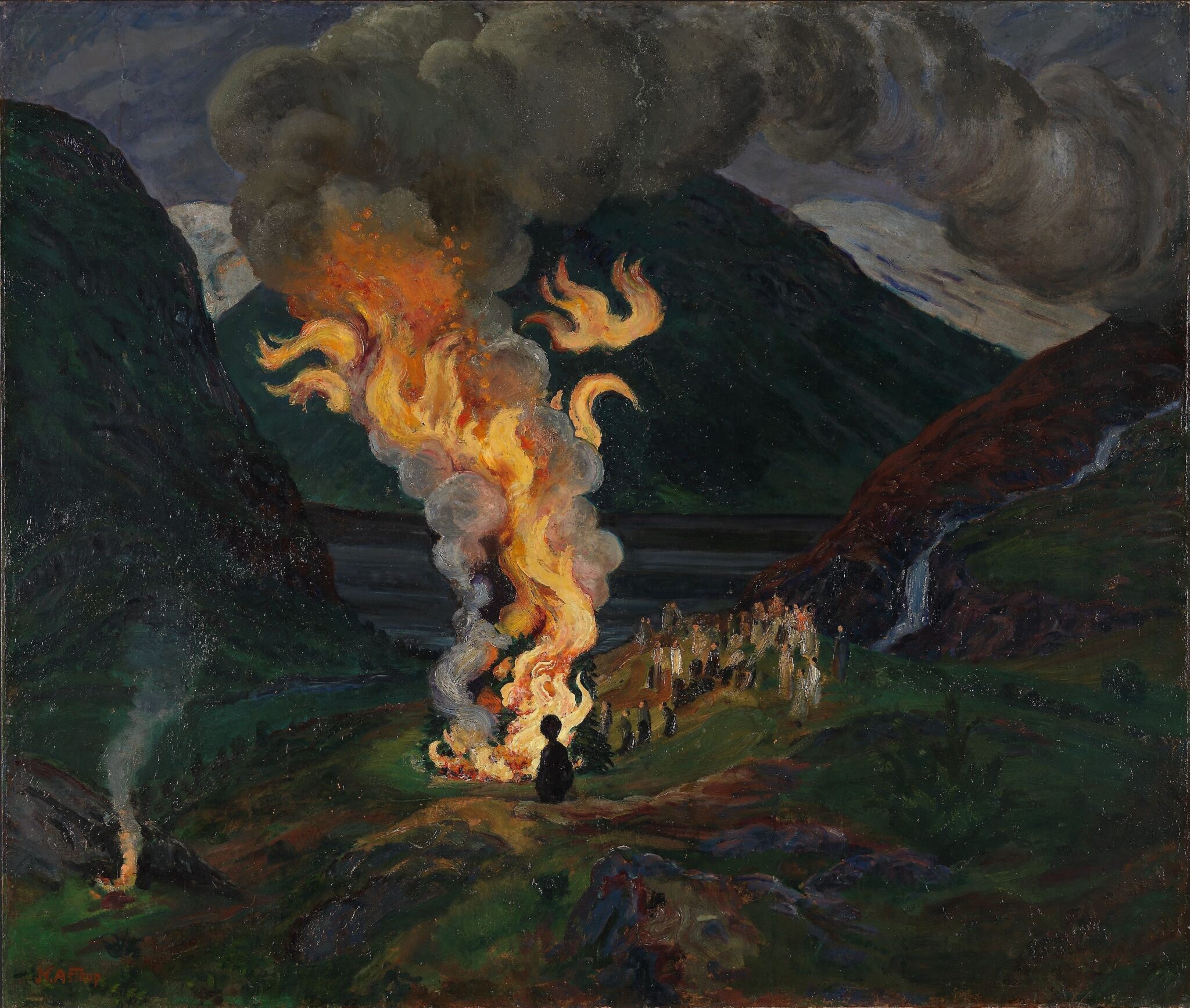
Image: Nikolai Astrup
Among the traditions associated with these seasonal thresholds are stories of what became known as need fires. Historical accounts describe communities extinguishing every hearth flame during times of hardship before gathering together to kindle a new fire through communal effort. Disease, famine, social upheaval, or other forms of collective distress often formed the backdrop for these ceremonies. Once the new flame was born, embers were carried back into homes and used to relight household hearths, creating a shared act of renewal that bound individuals, families, and communities into collective stewardship.
What continues to draw me toward these stories is the ecological imagination they reveal. The need fire emerged from a worldview that understood crisis not as an interruption of life’s processes but as part of the larger cycles through which life continually reorganizes itself. When every household flame was extinguished and that familiar light was set down, when communities gathered at the edge of uncertainty, they refused the illusion of private survival. From shared labor and breath, a new fire was coaxed into being, participated into emergence. From that flame, embers were carried outward, reweaving households back into a single living field of renewal.
To me, these were not merely rituals of protection from potential foreshadowing calamity, they were practices of re-entanglement and re-enchantment. A refusal of isolation at the moment when life had become difficult to read.
What moves through these stories is an ecological imagination that does not separate crisis from life’s ongoing processes of transformation. Nothing here stands outside of change. Forests teach this without instruction. Canopies open in storm and light returns differently. Fire clears what has accumulated beyond balance, and seeds that require heat begin their fugitive becoming. Beneath the forest floor, mycelial worlds redistribute what has fallen, composting endings into the conditions for what has not yet arrived, nothing is ever simply lost, only rearranged within the larger field of relation.
Today, many of us now find ourselves within a different kind of threshold. One shaped by the logics of modernity—extraction, acceleration, displacement, and cultural amnesia, the long severance from land, ancestry, seasonality, and more-than-human kinship. The grammar of this world has trained us into separation, into the fiction of autonomy, into solutions that often deepen the very fractures they seek to resolve.
In this condition, crisis appears in multiple registers at once: ecological disruption, political instability, economic precarity, psychic exhaustion, and a widespread sense of disorientation.
Please remember, beneath these surface expressions moves something more intimate. A grief that is not always named. A longing for reattachment. A remembering of relational worlds that still hum beneath the noise. Rituals that once carried communities through transition have thinned and fragmented under the pressures of modern life. For many our thresholds pass without sacred witness. Our grief circulates in private. Our renewal is performatively expected without ceremonial accompaniment. Life presses on, but often without the shared architectures that once held transformation as collective practice. Yes, these are part of our modernity, and still, the world does not cease its work.
Salmon travel ancient routes held in body and current. Rivers shape stone not through force but duration. Oaks and fungi maintain relationships that exceed human temporalities. The moon continues her gravity-braided conversation with the tides. These are not metaphors. They are ongoing correspondences in a more-than-human field that has never stopped speaking despite adversity.
To live here is to realize that modernity did not end these conversations. It only made them harder to hear. Despite everything that has been obscured, accompaniment persists. A patient intelligence of entanglement continues to compost what has been broken, redistributing possibility through networks that do not require permission to continue.
To approach the Summer Solstice through this lens is to enter a threshold where human time and Earth time briefly overlap in visibility. A moment when abundance and withdrawal are already braided. When flourishing and dissolution are not opposites but phases within the same ongoing movement of becoming.
May our modern need fire carry this memory not dressed up as nostalgia, but as breakthrough and instruction that reminds us renewal is rarely individual. It emerges through gathering. Through shared attention. Through practices that refuse isolation and return life to its relational fabric.
Like mycelial ecologies moving through darkness, redistributing what is needed where it is needed, these traditions point toward a world in which care is not centralized but woven. A care commons. A field of mutual accompaniment.
To approach the Summer Solstice through this lens is to encounter more than a seasonal celebration. The abundance of the season invites attention toward what has ripened within our lives, while the subtle turning already underway asks us to notice what may be preparing for release. The world around us offers no rigid distinction between flourishing and surrender, growth and decay, emergence and return. Each participates in the others through a web of relationships so intricate that no single thread can be understood apart from the whole.
We are being asked into fugitive becomings.
Perhaps this is why the image of the need fire continues to glow so brightly within the imagination. It carries the memory of communities who understood that renewal rarely arrives through isolation.
It emerges through participation, through gathering, through shared acts of remembering. Like mycelial networks carrying nourishment through darkness toward unseen futures, such traditions suggest that even during periods of uncertainty, pathways of connection remain available beneath the visible surface of things.
As the Summer Solstice approaches, I find myself returning to these images of fire, forest, reciprocity, and hidden networks of exchange. They feel less like relics of a distant past and more like living companions for a time in which many of us are searching for ways to remain rooted amidst profound change. Beneath the visible landscape of our lives, countless processes of adaptation, decay, regeneration, and emergence continue their quiet work, weaving futures that cannot yet be fully seen from where we stand.
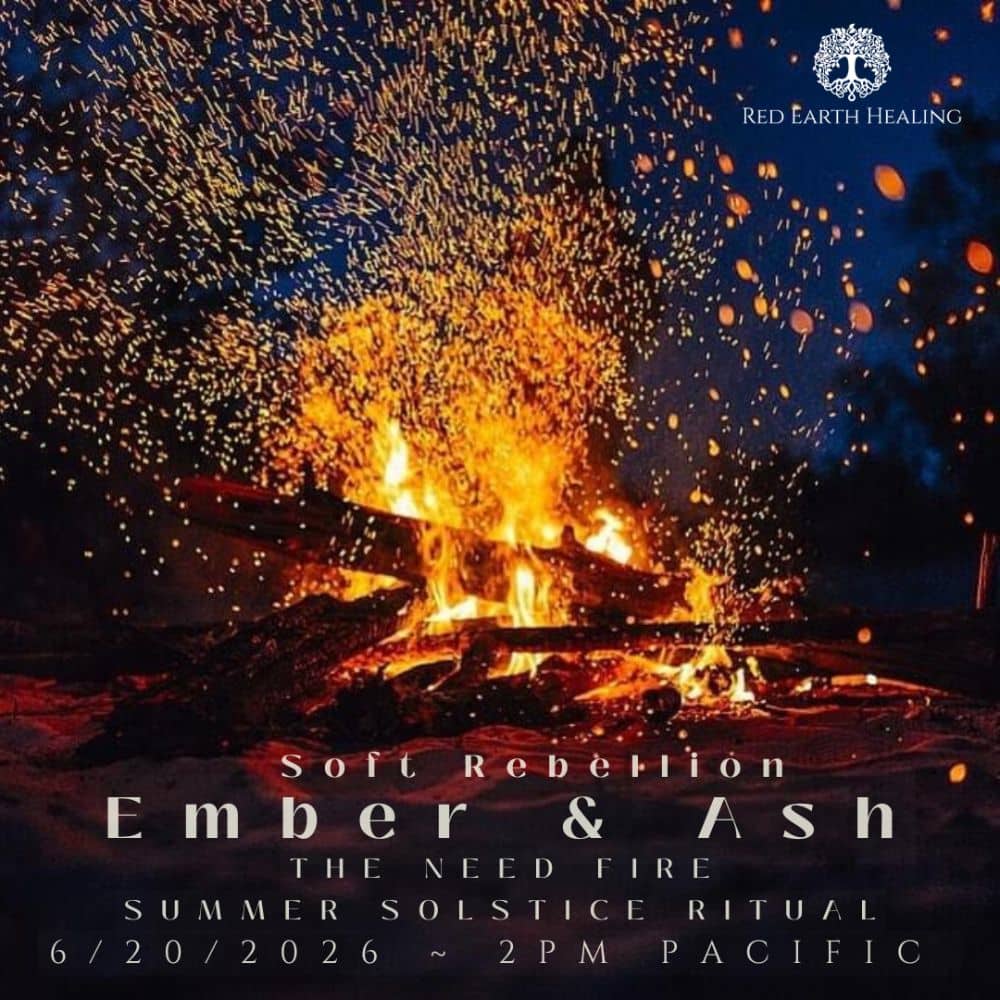
And from my hearth to yours,if you feel called to enter this threshold space, I will be hosting an online Summer Solstice Need Fire Ceremony on June 20 from 2:00 to 3:30 p.m. Together we will gather in the presence of this old image, listening for what is ready to be composted, what is ready to be carried forward, and what new forms of belonging may be asking to emerge through us as the wheel turns again.